432 Hz, 528 Hz and Solfeggio Frequencies: Exploring Healing Frequencies
If you have spent any time exploring sound healing, you have probably come across numbers such as:
432 Hz.
528 Hz.
639 Hz.
741 Hz.
Perhaps you have listened to a meditation recorded at one of these frequencies or seen them described as healing frequencies.
But what do the numbers actually mean?
And why might one frequency feel completely different from another?
At The Sound Temple, frequency sits at the heart of what we are famous for.
Every gong, bowl, drum, bell, voice and resonant instrument creates vibration.
We hear some of that vibration as sound.
We feel some of it through the body.
And sometimes we experience sound in ways that are much harder to put into words.
What does Hz mean?
Hz is short for hertz, which is a way of measuring frequency.
One hertz represents one vibration, or cycle, per second.
So 432 Hz means 432 cycles per second.
528 Hz means 528 cycles per second.
The number simply tells us how quickly the vibration is occurring.
But the experience of that vibration is another story.
A low resonant sound can feel grounding and expansive.
Higher tones may feel lighter, clearer or more energising.
Then there are the overtones and harmonics created by instruments such as gongs and singing bowls, where many frequencies can be heard and felt at the same time.
This is one of the things that makes sound healing so fascinating.
You are never experiencing just a number.
You are experiencing vibration.
What is special about 432 Hz?
432 Hz is one of the most recognised frequencies in the sound healing world.
Music tuned to 432 Hz is often described as softer, warmer and more naturally resonant than standard modern tuning.
Many people find it deeply relaxing.
There is something gentle about the way it lands.
Rather than demanding attention, it can seem to invite the body to soften.
For this reason, 432 Hz is often used during meditation, rest, sleep and sound healing practices where the intention is to slow down and move away from the constant stimulation of everyday life.
It is also one of the reasons music created specifically around 432 Hz has become so interesting to people working with sound.
The experience is not about analysing whether you can hear the difference.
Often it is simply about noticing how you feel.
432 Hz and the natural world
One reason 432 Hz has become so closely connected with sound healing is the idea of harmony with natural rhythms.
Within frequency-based practices, it is often viewed as a more natural tuning and is used to encourage a sense of grounding and reconnection.
Whether you are listening to music tuned to 432 Hz or experiencing layers of sound within a live sound session, the intention is often similar.
Less thinking.
More listening.
More feeling.
A return to ourselves.
At The Sound Temple, that sits very naturally beside our relationship with the land.
Sound does not exist separately from the space around it.
The custom built sound chamber.
The jarrah bush.
The birds outside.
The wind.
The silence between one sound and the next.
All of it becomes part of the experience.
What is 528 Hz?
528 Hz is another of the best-known healing frequencies.
It is sometimes referred to as the Love Frequency or the Miracle Frequency and is associated with transformation, restoration and positive change.
Within sound healing, 528 Hz is often used when the intention is to create a feeling of openness and renewal.
People may experience it as uplifting, expansive or emotionally moving.
Others simply enjoy the tone.
As with all sound, there is no need to decide beforehand what you are supposed to feel.
Listen first.
Notice later.
What are the Solfeggio frequencies?
The Solfeggio frequencies are a group of tones widely used in modern sound healing, meditation and frequency work.
The commonly used sequence includes:
174 Hz – often associated with grounding and a sense of safety.
285 Hz – connected with restoration and bringing the body back towards balance.
396 Hz – traditionally used around releasing fear, guilt and old emotional patterns.
417 Hz – associated with change, movement and clearing what is no longer needed.
528 Hz – linked with love, transformation and renewal.
639 Hz – connected with relationships, communication and harmony.
741 Hz – often associated with expression, clarity and clearing.
852 Hz – linked with intuition, awareness and deeper inner listening.
963 Hz – often used around connection, consciousness and spiritual awareness.
These frequencies are commonly used either individually or layered into music and meditation. We use tuning forks to bring these frequencies into our sound sessions.
Some people feel drawn to one particular frequency.
Others move between them depending on what they need at the time.
Do different frequencies feel different?
Absolutely. Do they sound different – Absolutely!
Anyone who has stood beside a large gong already understands this without needing to know the numbers involved.
A deep resonant gong can move through the body very differently from the delicate sound of a bell.
A drum feels different from a crystal bowl.
A human voice feels different again.
Frequency changes the experience.
Some tones feel grounding.
Some feel expansive.
Some seem to move attention into the body.
Others feel as though they create more space around the mind.
And then there are sounds that affect us emotionally for reasons we may not completely understand.
Sometimes a tone simply reaches somewhere.
More than one frequency at a time
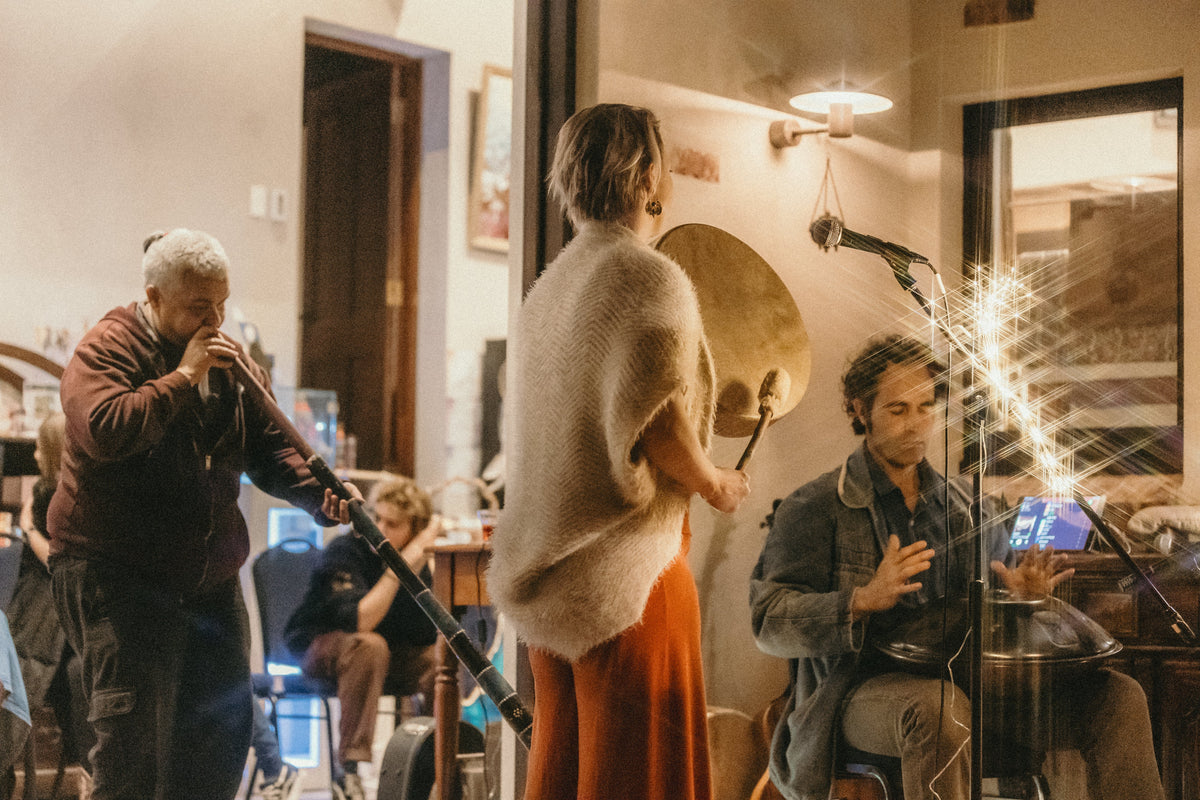
In a live Sound Healing Session, you are rarely receiving one isolated frequency.
A gong can produce an enormous range of harmonics and overtones.
Singing bowls create their own layers.
Voice adds another.
Drums create rhythm as well as vibration.
Didgeridoo brings another depth of resonance entirely.
These sounds interact with one another and with the temple itself.
Inside The Sound Temple's cedar and jarrah chamber, those vibrations move through the space and overlap, creating a complex soundscape.
Sometimes you can no longer tell where one sound begins and another ends.
That is part of the experience.
The body listens too
We often think of listening as something we do with our ears.
But sound is vibration, and vibration can also be felt.
You may notice a gong through your chest.
A drum through the floor.
A bowl as a gentle vibration.
A low vocal tone somewhere around the ribs or throat.
This is why sound healing can feel quite different from simply listening to music through headphones.
The experience can become physical.
You are not only hearing sound.
You are surrounded by it.
Why frequency is used in sound healing
Healing frequencies are not used because every person needs the same thing.
Quite the opposite.
Sound healing works beautifully because each session can meet people differently.
Someone may arrive exhausted.
Someone else may be emotionally full.
Another person may simply want quiet.
The frequency, rhythm, instruments and spaces between the sounds create an environment where the body can begin to respond in its own way.
There is nothing to achieve.
Nothing to analyse.
Nothing to force.
The sound does the moving.
You listen.
Intention also matters
Sound healing is not simply a mathematical exercise.
We could spend the entire session measuring frequencies and completely miss the experience.
The intention behind the sound matters too.
Why is this sound being played?
How is it being played?
What came before it?
What follows it?
Is the sound asking us to become still?
To release?
To ground?
To open?
To simply listen?
The facilitator, the instruments, the space and the person receiving the sound all become part of the same experience.
You may be drawn to different frequencies at different times
There may be periods when 432 Hz feels exactly right.
At another time, you may feel drawn towards 528 Hz.
Or perhaps it is a deep gong, a mantra or a drum that resonates with you instead.
Our relationship with sound changes.
So do we.
The same frequency can feel different depending on what is happening in our lives, our bodies and our minds.
That is why we encourage curiosity rather than expectation.
You do not need somebody else to tell you what you should experience.
Listen.
Notice.
Feel.
Try exploring frequency at home
Choose a time when you will not be interrupted.
Put the phone onto do not disturb.
Find a comfortable place to sit or lie down.
You might begin with music tuned to 432 Hz.
On another occasion, explore 528 Hz or one of the other Solfeggio frequencies.
Do not listen while answering emails or scrolling through your phone.
Give the sound your attention.
Notice whether your breathing changes.
Notice where you feel the vibration.
Notice whether your body wants to soften or move.
And notice how you feel when the sound stops.
Sometimes the silence afterwards tells us just as much as the sound itself.
The world of frequency
The deeper we go into sound, the more fascinating it becomes.
One vibration becomes a frequency.
Frequencies combine into harmonics.
Harmonics become layers of sound.
Sound moves through a space.
The body receives it.
And suddenly something we cannot see can become something we can very clearly feel.
At The Sound Temple, we have spent more than a decade exploring that relationship between sound, vibration, nature and ourselves.
There will always be more to learn.
More to listen to.
More to experience.
But perhaps we do not need to understand every frequency before we allow ourselves to feel it.
Sometimes the invitation is much simpler:
listen to the sound, feel the vibration and notice where it takes you.